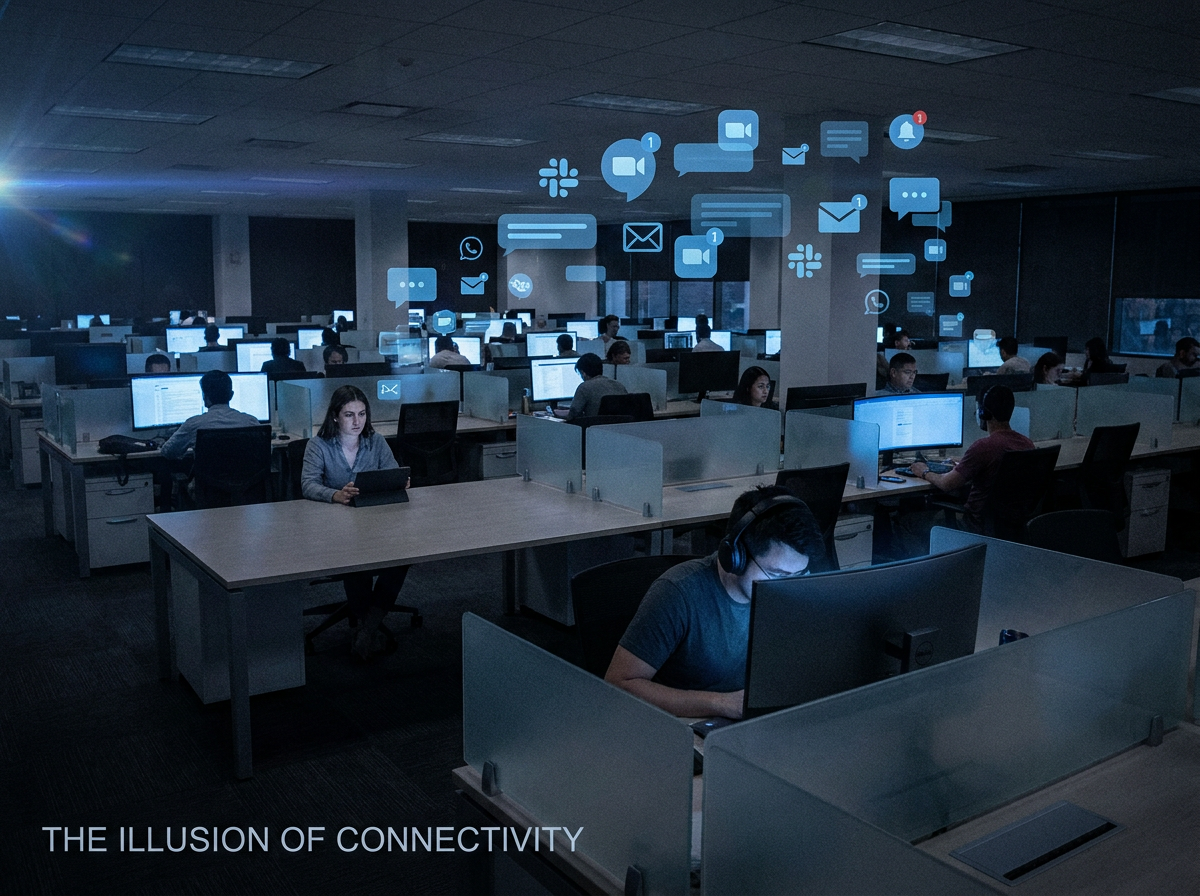
Look at your company's communication dashboard.
Look at the thousands of Slack messages sent per day. Look at the calendars, triple-booked with back-to-back Microsoft Teams meetings. Look at the culture deck that proudly uses the word “community” fourteen times.
By every modern metric of organizational health, your company is hyper-connected.
But if you run an honest, anonymous diagnostic, you will find a terrifying truth:
Your people are profoundly, chronically lonely.
We have accidentally built the organizational equivalent of a social media platform. We have created an environment explicitly optimized for the performance of connection, rather than the experience of it.
And in doing so, we haven't just destroyed the Human Experience of our workforce. We have destroyed their capacity to actually think.
The Anatomy of the Loneliness Factory
In 2023, the US Surgeon General issued an 81-page federal advisory declaring a national epidemic of loneliness and isolation. The data is staggering: chronic loneliness increases the risk of premature death by 29% — carrying the same health impact as smoking 15 cigarettes a day.
How did we get here? We mistakenly believed that volume of communication equaled depth of connection.
When we moved to open-plan offices and “always-on” collaboration tools, we fundamentally altered human neurobiology. We took brains that evolved to build deep, sustained trust in small groups, and forced them into a state of Continuous Partial Attention.
Your employees are switching tasks an average of 566 times across an 8-hour workday.
They are fielding pings, notifications, and urgent “quick questions” every 51 seconds.
Neuroscientist Earl Miller at MIT has documented that “multitasking” is a biological impossibility. Every task-switch carries a massive cognitive cost — it leaves a “residue” that contaminates the next thought.
Your team is not “agile.” They are exhausted. They are perpetually visible, yet perpetually unknown. And that is the exact recipe for modern, corporate loneliness.
The Violence of Distracted Leadership
The philosopher Simone Weil argued that the capacity to be genuinely present with another human being is the foundational act of love and justice. She called distracted attention a form of violence.
In the corporate world, this quiet violence happens every single day.
It happens in the 1-on-1 performance review where your phone is face down on the table — a physical gesture of presence that is simultaneously a threat of sudden absence. Research from the University of Texas found that the mere presence of a smartphone on a desk, even if it is turned off, measurably reduces your cognitive capacity.
It happens when you are half-reading an email while nodding on a Zoom call.
When leaders are chronically distracted, research shows they become measurably less empathetic. You lose the ability to read the micro-expressions and emotional states of your team.
You are giving them the neurochemical taste of human connection without any of the actual calories. And like any nutritionally empty food, it leaves your team starving.
The Avoidance of Deep Work
Why do we tolerate this? Why do leaders allow their calendars to be consumed by recurring meetings that produce no documented decisions?
Because hyper-connectivity is the ultimate corporate anesthetic.
Blaise Pascal, 1670
“All of humanity's problems stem from man's inability to sit quietly in a room alone.”
Deep work — the focused, uninterrupted, sustained attention required to solve complex problems, write strategy, or invent new products — is incredibly uncomfortable. It requires facing the void. It requires wrestling with your own incompetence.
It is much, much easier to answer 40 Slack messages and attend five mediocre meetings. It gives your brain a cheap, immediate hit of dopamine. You feel “productive,” even though you have produced absolutely nothing of lasting value. We use busyness as a shield against the vulnerability of deep thought.
The H2H Experiment: The Attention Audit
You cannot solve a structural attention crisis with a wellness app or a “Mindful Monday” yoga session. You have to change the architecture of the work. This week, audit your environment:
The Meeting Purge
Eliminate every recurring meeting on your calendar that does not result in a documented, strategic decision. If it is just a "status update," it does not deserve human oxygen.
Protected Deep Work
Institute non-negotiable blocks of deep work for your entire organization. Three times a week, for three hours, mandate a total blackout of internal messaging. No Slack. No Teams. No expectations of a reply. Give them their minds back.
The No-Device 1-on-1
The most underutilized leadership tool is the agenda-light, genuinely curious 1-on-1. Take your direct reports for a walk. Leave your phone at your desk. Do not ask for a status update. Ask them what they are experiencing. And then, be completely, uncomfortably silent.
Final Reflection
Seneca, 65 AD
“He who is everywhere is nowhere.”
For the last decade, corporate leadership has demanded that employees be everywhere. On every channel. In every meeting. Responsive at all hours.
And the result is a workforce that is nowhere. Burned out, lonely, and biologically incapable of the deep, sustained thought that actual innovation requires.
The most radical, subversive act of leadership in 2026 is not a new software deployment.
It is the decision to protect human attention.
Stop managing the performance of connection. Start building the infrastructure for it.
— Joao Pereira
References
- Murthy, V. (2023). Our Epidemic of Loneliness and Isolation: The U.S. Surgeon General's Advisory. US DHHS.
- Ward, A.F. et al. (2017). Brain Drain: The Mere Presence of One's Own Smartphone Reduces Available Cognitive Capacity. Journal of the Association for Consumer Research.
- Miller, E.K. & Buschman, T.J. (2015). Working memory capacity: limits on multitasking. MIT.
- Lieberman, M.D. (2013). Social: Why Our Brains Are Wired to Connect. Crown Publishers.